
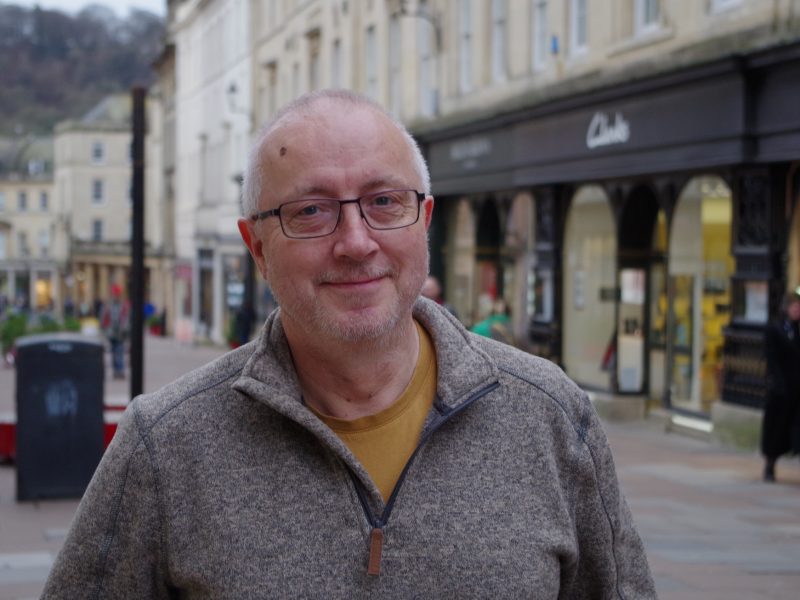
By Harry Mottram: In a broad attack on the Liberal Democrat administration in the Guildhall the Councillor for Westfield Robin Moss has listed a number of criticisms on housing, transport and its reliance on a low wage hospitality economy linked to the Local Plan.
He said that two recent major policy proposals could turn Bath into ‘a city that’s mainly for wealthy out-commuters, students, and tourists.’ The Labour opposition leader warned that prioritising low-wage hospitality and tourism over the district’s high-value potential ‘jeopardises not only Bath’s economic promise, creative capacity and social diversity, but also the unique heritage of the surrounding towns and villages.’
Another criticism was that the new Local Plan doesn’t plan for the affordable homes Bath needs, which will lead to ordinary people being priced out of the city. He said: “Local lower-than-average pay, much higher-than-average property costs, and under-performing economy will force them to move into more affordable housing developments – which the Local Plan suggests should be built in B&NES’ outlying villages and towns, and not in Bath.”
He said that ‘forcing younger people to move further and further out will fracture communities.’ And he took a shot at the second policy document – a Movement Strategy For Bath which he said hasn’t put a major public transport system at its heart. And he said, ‘the Lib Dem administration seem to accept that their housing approach will generate extra car-miles, congestion, co2 and economic harm – when instead, they could be imagining a more vibrant future.’
“I was so disappointed when I read these major housing and ‘movement’ proposals,” says Cllr Robin Moss. “The council has a net zero policy, and so it needs a serious plan for public transport for today’s residents, let alone to cope with the extra 27,000 homes that are on the way.
“We need homes- and we need affordable ones. We’ve had yet another increase in the number of local people who are amongst the country’s poorest 10%. Even priority residents wait a year and a half for a home, because there’s almost 5,000 households on the waiting list but already we have over 23,000 students in Bath taking up private rental properties.
“This Lib Dem Local Plan suggests that because B&NES wants to hold onto its UNESCO status, we can’t build the homes that bath people need. But our economy needs homes and jobs. While the west of England’s economy grew 55% in the three years between ’98-’21, and England’s grew 50%, B&NES’ growth was just 11%.”
The Labour Group called on B&NES to do the following for the next stages of this work:
Promise Bath the homes – and affordable homes – that its residents need, and treat north east somerset’s distinct communities with similar respect
Prioritise residents’ homes before student accommodation
Fully assess the economic benefits and disbenefits of UNESCO inscriptions across B&NES, working with stakeholders (residents, businesses, stakeholders) to define the scope of that research
Include already permitted but unbuilt homes in the housing targets
Work with WECA to develop a local bus service that is a “happy choice”: reliable, frequent, great coverage, usage-data-led, and safe, connecting homes, work, health facilities, education, leisure and culture
Make an economic case for improved bus services by weighing social costs and benefits. Educational and vocational opportunities over residents’ lifetimes are crucial factors to consider.
Provide park and rides that cover north, east, south and west, that are safe and appealing, enable multi-modal switching and are open for longer
Maximise the potential of WECA’S record-breaking £0.8 billion transport funding, B&NES’ own role in chairing the WECA transport board, and forthcoming government policy on how we all travel.
Ensure night economy staff always have access to safe public transport
Ensure our most deprived communities can access work, leisure, green spaces, social opportunities, and education without having to have a car.
From the council:
Planning decisions in Bath and North East Somerset are guided by national and local planning policy. Our local planning policy is made up of a series of documents, which include the following:
- Local Plan (Core Strategy, Placemaking Plan and Local Plan Partial Update, or LPPU)
- Neighbourhood Plans
All Plans are also supported by a substantial number of evidence base documents. These are relevant and up-to-date research reports on subjects such as economic and population data, housing need, and environmental information. We have a legal duty to regularly review and update these documents, and cannot adopt a new Local Plan if we cannot show the evidence we have used to inform our policy decisions. The emerging Local Plan will establish the planning framework for Bath and North East Somerset up to 2042. It will contain a vision, strategy and policies to guide and manage how the district grows and changes over the next 15 to 20 years, and how planning applications for new development are decided. Because a Local Plan deals with very broad issues, such as housing, travel, business and the environment, there are important areas of policy where local councils need to work together at a regional level. How our Local Plan sits within the regional strategic planning framework
The Council commenced work on the emerging Plan in 2022, however, in December 2024 changes were made to national planning policy. This included changes to the way housing targets are calculated and how the Green Belt is defined. To respond to these changes, the Plan making process has been reset including engagement and consultation activities.
For details of the work of the Local Plan see https://bathnesplaces.co.uk/localplan/ and at https://www.bathnes.gov.uk/local-plan
From the Government:
What are Local Plans?
Local Plans, prepared by a local planning authority in consultation with its community, set out a vision and a framework for the future development of an area. Once in place, Local Plans become part of the statutory development plan. The statutory development plan for the area is the starting point for determining local planning applications.
What do you think? Letters to the editor by email to news@bathvoice.co.uk

Bath Voice and Local Democracy Reporters
The journalists are funded by the BBC as part of its latest Charter commitment, but are employed by regional news organisations. A total of 165 reporters are allocated to news organisations in England, Scotland, Wales and Northern Ireland including Bath Voice. These organisations range from television and radio stations to online media companies and established regional newspaper groups. Local Democracy Reporters cover top-tier local authorities, second-tier local authorities and other public service organisations.
Bath Voice Monthly Newspaper is distributed free to thousands of homes and some supermarkets – distributed from the first of the month. Harry Mottram is the News Editor
Email him at news@bathvoice.co.uk Bath website: https://bathvoice.co.uk/news/
Bath Facebook: https://tinyurl.com/bdtf2kep Also on Twitter: https://twitter.com/bath_voice And Bluesky @bathvoicenews.bsky.social And also on Instagram https://www.instagram.com/harrymottram6/
Read the newspaper online at :https://issuu.com/bathvoice
To advertise to thousands of Bathonians call Shaun on 07540 383870 or email him on sales@bathvoice.co.uk