
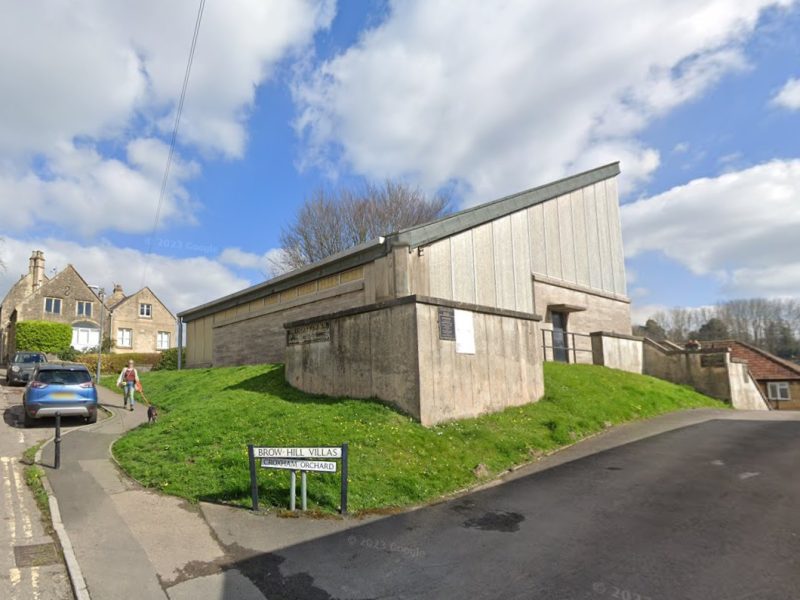
By John Wimperis, Local Democracy Reporter: An unusual brutalist church in a village near Bath has been put up for sale as a “development opportunity.”
Planning permission was granted for the Church of the Good Shepherd to be demolished last year. The catholic village church, which has always divided opinion locally for its striking brutalist design, had closed in 2020. Now the Diocese of Clifton is putting the unique building up for sale.
A listing on property website Rightmove said: “Connells are delighted to present an exciting residential development opportunity in the highly sought-after village of Batheaston, Bath. Located on Brow Hill, the site benefits from full planning consent for the erection of four dwellings with associated landscaping and parking, following the demolition of the existing mass centre (former church).
“In addition to the development site, the property includes an attractive grade II listed building, currently arranged as two self-contained one-bedroom apartments with the added advantage of communal storage space and a private rear garden.”
Offers are invited by the end of January, with the church to be sold through informal tender. Interested parties are invited to bid for either the former church, the adjoining grade II listed apartments, or both.
Built in 1967, the bold angular design of the church stands out against the Georgian homes of little Batheaston and is still provoking debate today. While some call the little catholic church the “village joke,” others see it as an “important historical statement” and it has now been locally listed.
Over 700 people have signed a petition on change.org urging the Bishop of Clifton to give locals the first chance to buy the church. Petition starter Sasha Laskey wrote: “The Church of the Good Shepherd has stood as a beacon of unity and community spirit in Batheaston, a space where individuals from various walks of life came together, fostering bonds of belonging, trust, respect, and pride.
“As the future of this site hangs in the balance, we, as residents committed to preserving our shared values, call on the Bishop of Clifton, the Right Reverend Bosco MacDonald, to grant our community the first option to purchase the site, and up to six months to formulate a development plan that aligns with our community’s interests.”
She added: “Our community is not averse to redevelopment or repurposing. Instead, we see this as an opportunity to shape a new chapter for the site that has been part of our village for over 50 years and that remains true to its original spirit of service to the community.”
The church was designed by Bath architect Martin Fisher — who was also behind the design of St Peter and Paul’s in Combe Down — and consists of poured concrete blocks. It does not have a traditional spire, but instead its square roof slopes up to the south east corner, reflecting the tent of a travelling pilgrim.
Rather than stained glass, it uses blocks of a material called “Kalwall,” which look almost concrete-like from outside. Their coloured pattern can be seen from the inside as the light shines in through the window but is only revealed to people outside when the church is lit up from within.
After plans to demolish the church were submitted, Bath and North East Somerset Council’s conservation expert Caroline Power said the architectural value of the building had been “underplayed by the applicants.” She had the church locally listed as a non-designated heritage asset.
She said: “The church is a landmark structure that contributes towards the character of the locality and is worthy of retention, despite its contrasting materiality and built form. Solutions demonstrating its re-use as part of the redevelopment of this site should be provided before demolition is considered.”
Emblematic of the changing face of the Catholic Church, the Church of the Good Shepherd was the first church in the area built after the major changes of Vatican II and adopted the now iconic brutalist style of the times. Three years later, similar ideas would lead to the construction of Clifton Cathedral in Bristol, the seat of the bishop. Clifton Cathedral was Grade II* listed in 2000.
Bath Voice and Local Democracy Reporters
The journalists are funded by the BBC as part of its latest Charter commitment, but are employed by regional news organisations. A total of 165 reporters are allocated to news organisations in England, Scotland, Wales and Northern Ireland including Bath Voice. These organisations range from television and radio stations to online media companies and established regional newspaper groups. Local Democracy Reporters cover top-tier local authorities, second-tier local authorities and other public service organisations.
Bath Voice Monthly Newspaper is distributed free to thousands of homes and some supermarkets – distributed from the first of the month. Harry Mottram is the News Editor
Email him at news@bathvoice.co.uk Bath website: https://bathvoice.co.uk/news/
Bath Facebook: https://tinyurl.com/bdtf2kep Also on Twitter: https://twitter.com/bath_voice And Bluesky @bathvoicenews.bsky.social And also on Instagram https://www.instagram.com/harrymottram6/
Read the newspaper online at :https://issuu.com/bathvoice
To advertise to thousands of Bathonians call Shaun on 07540 383870 or email him on sales@bathvoice.co.uk