
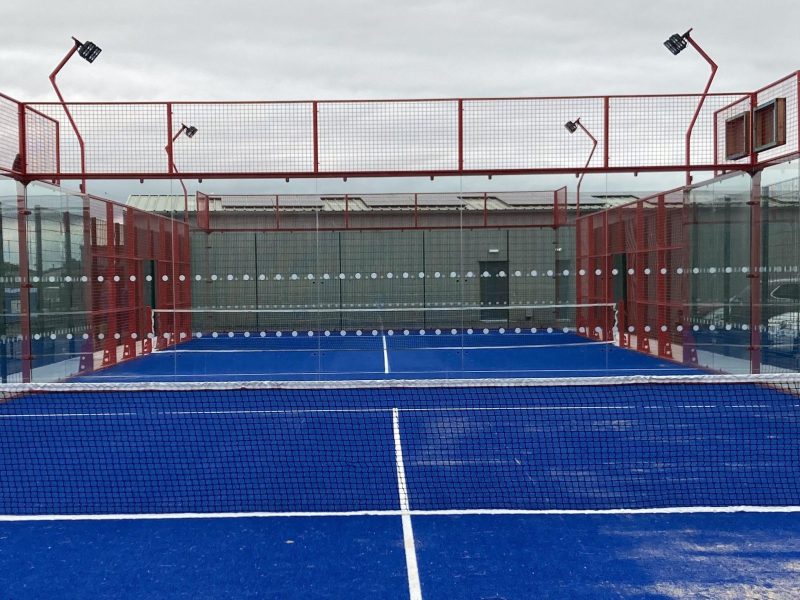
Padel Courts at Rugby Club
By John Wimperis Local Democracy Reporter: A rugby club near Bath has become the latest to try and build the city’s first padel courts.
Walcot Rugby Club wants to build four padel courts at its grounds on Lansdown Road, just north of the city. The rugby club said that there were fewer people playing rugby, while padel was growing in popularity but there was nowhere in Bath to play it.
Bath and North East Somerset Council’s planning committee has twice refused planning permission for padel courts in the city itself over concerns the “gunfire-like” noise of the game might harm neighbours’ mental health. Last month, some courts at the University of Bath finally were approved, but Walcot RFC said its plan would serve the other side of the city.
The rugby club wants to build four courts under a lightweight canopy over a small area used for training next to its pitches. The planning application stated: “The small loss of the peripheral training paddock is more than offset by the alternative specialist facilities proposed, particularly given the recognised under provision of such courts within the city area.”
It said: “By diversifying the sports attraction Walcot RFC aim to maintain a viable club, both financially, but also broadening its attraction, and simply offering greater facilities for instance for parents whilst their children attend training sessions.”
Padel is a sport similar to squash but plated with a solid racquet. Originally from Mexico, the sport has boomed in popularity since the Covid-19 lockdown and is one of the fastest growing sports.
Another planning application to build padel courts on another side of Bath, at the former railway station in Bathampton, is also pending. A decision on that application is expected by June.
Walcot RFC’s plans are open for comments until May 25 and a decision is expected by June 25. You can view and comment on the plans here: https://app.bathnes.gov.uk/webforms/planning/details.
Labour slams RUH pay plans
By John Wimperis Local Democracy Reporter: A councillor has branded plans to transfer hundreds of NHS staff across Bath and North East Somerset and Wiltshire to a private company “not acceptable.”
Bath’s Royal United Hospital — together with Salisbury NHS Trust and Swindon’s Great Western Hospital NHS Trust — plans to transfer hundreds of staff to private company Pulse on August 1. Robin Moss, who leads the opposition Labour group on Bath and North East Somerset Council, said Labour councillors had written to health secretary Wes Streeting to raise their concerns.
Mr Moss said: “It is not acceptable, in my view, to degrade the pay and conditions of part-time staff, a high proportion of whom tend to be women. I’m also not clear about how this decision had actually been made, who has been consulted, and therefore its legitimacy in view of those questions.”
Pay is not expected to be affected under the plan, but conditions of employment could change as staff will not be eligible for TUPE (transfer under protected employment) to Pulse. It is “bank” staff, who pick up flexible shifts to cover staff absences or increased demand on the NHS, who would be affected by the move.
Although pay would not be affected, the two fifths of bank staff who do not also have full-time NHS contracts could lose thousands of pounds in lost retirement savings. Instead of an NHS pension contribution of 23.7%, they would receive an employer pension contribution of 6% once they are transferred to Pulse.
Mr Moss said: “How does this make patient healthcare better if you are demoralising staff? […] How do we think privatising part of the NHS is a good idea and why haven’t you told people about what you always knew was going to be a complicated decision?”
The three trusts, who work together as BSW Hospitals Group, said they had followed the required legal process and did not need to consult with the local authority, but accepted that they should have communicated better. The plan to transfer the staff was only revealed when Unison representative Baz Harding-Clark and former RUH governor Nicola James raised it at a Bath and North East Somerset Council health scrutiny committee meeting in April.
The NHS integrated care board, which is responsible for commissioning care across Bath and North East Somerset and Wiltshire area, was only told about it by the RUH the morning of that meeting. Committee chair Dine Romero has written to the NHS trusts for more information ahead of also writing to raise the issue with Wes Streeting.
A spokesperson for BSW Hospitals Group said: “Throughout the process to outsource the temporary staffing service we engaged with partners that included our staff-side trade unions, workers and employees in line with our statutory obligations to consult. The programme of work created multiple opportunities for all stakeholders to review proposals, ask questions, and provide feedback.
“With the benefit of hindsight, we have acknowledged that communication with the local authority scrutiny panel could have been more efficient.
“We are committed to supporting all affected workers and will make every effort to ensure a smooth transition to the new provider. We also encourage bank workers, where appropriate, to apply for suitable substantive roles as they become available.”
Free school meal vouchers
From the Council: Bath & North East Somerset Council is changing the way it supports families who currently receive free school meal vouchers during school holidays.
The council will continue providing vouchers through the summer school holidays, after which support will be delivered in a more targeted way, focused on helping families facing financial difficulty and strengthening longer‑term financial resilience. It is not a withdrawal of support but change in the way it is provided.
The vouchers are funded through the UK Government–supported Crisis & Resilience Fund, which is a short‑term response to financial hardship rather than a permanent scheme. Government rules attached to the fund do not allow councils to run ongoing blanket voucher programmes.
Families facing financial difficulty will still be able to apply for crisis support through the Crisis & Resilience Fund, with payments made as cash where possible to give people greater flexibility. The council’s Welfare Support team will also continue to help residents with essential costs, including food through the existing Local Welfare Provision scheme.
Alongside this, the council working with partners will help households improve their financial stability through practical budgeting support, advice on bills and debt, and ways to maximise income.
For more information go to https://www.bathnes.gov.uk/changes-free-school-meal-holiday-vouchers.