

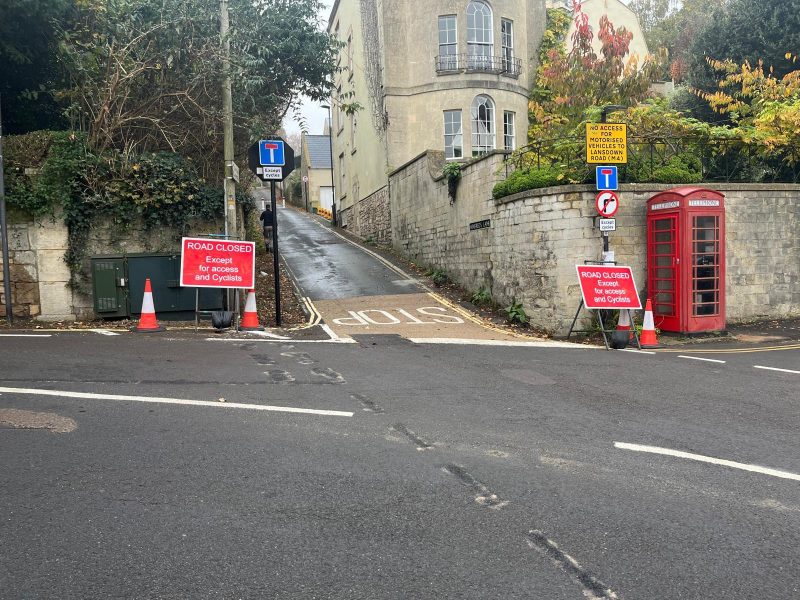
By John Wimperis, Local Democracy Reporter: The controversial closure of Winifred’s Lane in Bath is set to stay after a council scrutiny panel voted down a bid to challenge it.
Locals wanting the road reopened warned that closing the one-way road at the top of Cavendish Road — which was previously used by 1,300 vehicles a day — had just displaced the traffic, turning a road past a primary school into “a bedlam of vehicles” and leading to accidents. But supporters say it would be more dangerous to have Winifred’s Lane back open, with one councillor calling the narrow and largely pavementless lane “a potential pedestrian death trap.”
The lane was closed to thorough traffic on a trial basis in November 2024 as part of Bath and North East Somerset Council’s programme of liveable neighbourhoods (also known as low traffic neighbourhoods or LTNs) and council cabinet members decided last month to make it permanent — despite 72% of people in the local are opposing the move in a council consultation.
Nine Independent, Labour, and Conservative councillors called in the decision to make it permanent, bringing it before the council’s climate and sustainability scrutiny panel on February 23. But the panel voted to dismiss the call-in instead of challenging the decision. It is the third time that councillors have signed a call in of a liveable neighbourhood in Bath only for it to be dismissed by the scrutiny panel.
Leading the call in, Colin Blackburn (Westmoreland, Independent) told the meeting: “The Winifred’s trial has failed when measured against the council’s own objectives: it has made our school routes more dangerous, our air more polluted in high density areas, and ignored the overwhelming opposition of the local community.”
But councillor Mark Elliott (Lansdown, Liberal Democrat), whose ward includes Winifred’s Lane, said: “There seems to be an assertion from those opposing the scheme that there was nothing wrong before. That is simply not true.
“Winifred’s Lane itself was — I would assert — potentially lethal for pedestrians with 1,300 cars a day hurtling up a lane barely the width of the car, no pavements for most of its length, high walls and thick hedges on either side.”
He said: “I acknowledge there is more we can do but this scheme has reduced northbound traffic by 40% and turned a lane that was a potential pedestrian death trap into a lane where you can happily let your kids walk unaccompanied.”
There was a packed public gallery watching the three hour long meeting, and councillors heard speeches from 13 members of the public.
Speaking in support of the liveable neighbourhood, Theresa Franklin said: “I have spent many hours on Cavendish Road and Winifred’s Lane with the speedwatch team and have first hand experience of counting traffic, measuring car speed, and, sadly, of bad threatening behaviour by motorists — one of whom is in this room.”
Neil Dickinson added: “The volume and speed of traffic which we had before was totally unbelievable. […] Something had to be done. This was an accident waiting to happen.”
But objectors warned that accidents were happening now as a result of the scheme. Council data shows that although traffic has reduced on Cavendish Road and other nearby roads as a result of the scheme, cars going up the slower part of Sion Road — which features blind bends and the entrance to a private primary school — has roughly doubled.
Robert Parker said: “An increase in the number of accidents in this area is inevitable and already evidenced but omitted from the report. […] At peak times, the affected section of Sion Road near the gates of Kingswood Prep School is now a bedlam of vehicles attempting valid journeys north or south.”
Tim Spratt added: “A four tonne lorry wrote off a resident’s car on the blind bends of Sion Road. It was reported but did not appear anywhere in the report.” He added: “No-one is saying do nothing […] Simply swap the bollards at the end of Winifred’s Lane for speedbumps.”
Before the trial Sion Road carried around 1,022 vehicles per day, but during the trial it saw on average another 887 to 1,174 a day. “Poor driver behaviour” was also noted by the council. The council has said it will make “mitigations” on the road.
Winifred’s Lane forms one part of the “Lower Lansdown and Circus Liveable Neighbourhood,” together with the changes to Gay Street and the through-traffic restriction on Catharine Place which have been generally accepted. The cabinet members who took the decision to implement the scheme said the three schemes were designed to work together and that Winifred’s Lane could not be considered separately.
Cabinet member for sustainable transport strategy Joel Hirst (Odd Down, Liberal Democrat) said: “The three linked schemes are transformational, are reducing through traffic in predominantly residential areas. Safety and regulations were considered very carefully.”
Responding to the concerns raised in the meeting, cabinet member for communities and consultation Manda Rigby (Bathwick, Liberal Democrat) said: “I am not going to go through some of the individual things that have been said today that we reject but I do absolutely want to say we reject any implication that this was predetermined, we want to reject any implication that the data we based our decision on was flawed, and we want to reject any implication at all that the process was not followed absolutely to the nth degree.”
Debating the call in, scrutiny panel member Tim Ball (Twerton and Whiteway, Liberal Democrat) said: “I’m a liveable neighbourhood sceptic […] I don’t always agree with the procedure with liveable neighbourhoods but that’s not what I’m here for. I’m here to scrutinise how this was actually come to. I think very clearly the decision they came to was actually done properly.”
But Joanna Wright (Lambridge, Green) said: “I am disappointed by this process. I am disappointed by this scrutiny panel.” Ms Wright wrote the council’s liveable neighbourhood policy before defecting from the Liberal Democrats to the Greens. She has been a leading critic of how that policy has been subsequently interpreted.
The panel voted 6-1 to dismiss the call in, with two councillors abstaining from the vote.
A spokesperson for the Heart of Lansdown Conservation Group, which has consistently campaigned against the scheme, said: “How is that 72% of local residents living near to Winifred’s Lane, as reported by the council’s own documentation, want the lane to stay open, yet have been ignored? Is this how democracy now works in Bath? We’ve been left behind.”

Bath Voice and Local Democracy Reporters
The journalists are funded by the BBC as part of its latest Charter commitment, but are employed by regional news organisations. A total of 165 reporters are allocated to news organisations in England, Scotland, Wales and Northern Ireland including Bath Voice. These organisations range from television and radio stations to online media companies and established regional newspaper groups. Local Democracy Reporters cover top-tier local authorities, second-tier local authorities and other public service organisations.
Bath Voice Monthly Newspaper is distributed free to thousands of homes and some supermarkets – distributed from the first of the month. Harry Mottram is the News Editor
Email him at news@bathvoice.co.uk Bath website: https://bathvoice.co.uk/news/
Bath Facebook: https://tinyurl.com/bdtf2kep Also on Twitter: https://twitter.com/bath_voice And Bluesky @bathvoicenews.bsky.social And also on Instagram https://www.instagram.com/harrymottram6/
Read the newspaper online at :https://issuu.com/bathvoice
To advertise to thousands of Bathonians call Shaun on 07540 383870 or email him on sales@bathvoice.co.uk